
Please enter the value below to convert between Meter to Kilometer or vice versa.
hi
hh
Details for Meter – The Foundation of Modern Measurement
Introduction : The meter is the basic unit of length in most countries around the world. It’s roughly the distance from the floor to a doorknob or about one large step. Slightly longer than a yard, the meter helps measure everything from a person’s height to a room’s size. It scales easily up to kilometers or down to millimeters using simple prefixes.
History & Origin : The meter was born during the French Revolution in the 1790s. French scientists defined it as one ten‑millionth of the distance from the equator to the North Pole. They created a metal bar as the official reference. In 1983, they redefined it using the speed of light. Today, it’s based on how far light travels in a tiny fraction of a second.
Current Use : People use meters for height, room sizes, and swimming pool lengths. Athletes run the 100‑meter dash. Builders and architects design houses in meters. Scientists rely on it for other units like newtons and pascals. Even in the United States, doctors and engineers regularly use meters for precision work.
Details for Kilometer – Measuring the World’s Distances
Introduction : The kilometer is simply a thousand meters put together. It’s the go‑to unit for measuring longer distances like travel and geography. One kilometer is about a 15‑minute walk at a relaxed pace. For people used to miles, a kilometer is just over half a mile. The prefix ‘kilo’ means thousand in Greek.
History & Origin : The kilometer appeared with the metric system during the French Revolution. By the mid‑1800s, many European countries used it for roads and railways. Great Britain and the United States stuck with miles for a long time. Today, nearly every country except the United States, Liberia, and Myanmar uses kilometers for road signs.
Current Use : Road signs in most countries show distances in kilometers. Car speedometers use kilometers per hour. Fitness apps track 5K and 10K runs easily. Marathons are 42.195 kilometers long. Weather reports mention visibility in kilometers on foggy days. Maps on your phone show scales in kilometers for easy navigation.
Conversion Formula for Meter to Kilometer
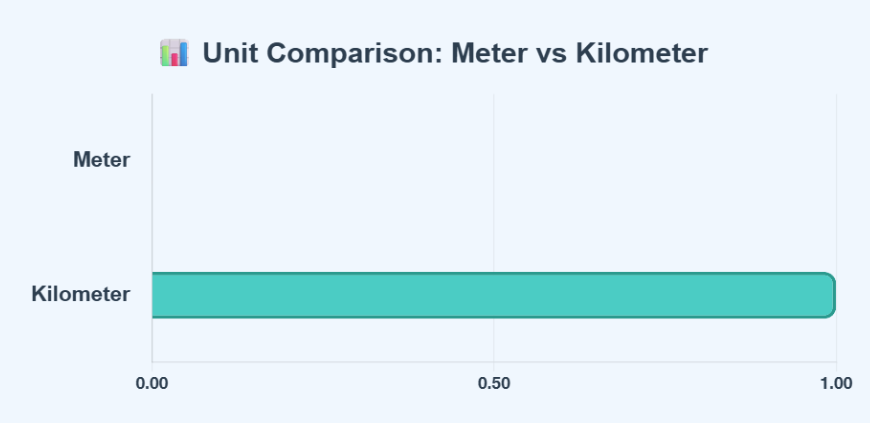
Converting meter into kilometer is a simple process once you know the basic relationship between the two units. One Meter is equal to 0.001 Kilometer, while one Kilometer contains 1,000 Meter.
To change a measurement from meter to kilometer, you only need to multiply the number of meter by 0.001.
1 Meter = 0.001 Kilometer
1 Kilometer = 1,000 Meter
This gives you the equivalent value in kilometer quickly and accurately. By using this straightforward formula, you can easily switch between these units whenever needed.
Meter to Kilometer Conversion
Converting meter to kilometer is an easy process once you know the correct conversion factor. One Meter is equal to 0.001 Kilometer, so you can find the value in kilometer by multiplying the number of meter by this figure. Example:-
| Meter | Kilometer |
|---|---|
| 0.01 Meter | 0.00001 Kilometer |
| 0.1 Meter | 0.0001 Kilometer |
| 1 Meter | 0.001 Kilometer |
| 2 Meter | 0.002 Kilometer |
| 3 Meter | 0.003 Kilometer |
| 5 Meter | 0.005 Kilometer |
| 10 Meter | 0.01 Kilometer |
| 20 Meter | 0.02 Kilometer |
| 50 Meter | 0.05 Kilometer |
| 100 Meter | 0.1 Kilometer |
| 500 Meter | 0.5 Kilometer |
| 1,000 Meter | 1 Kilometer |
| Foot to Meter 1 Foot = 0.3048 m | Meter to Foot 1 Meter = 3.280839895013 ft |
| Foot to Kilometer 1 Foot = 0.0003048 km | Kilometer to Foot 1 Kilometer = 3280.839895013123 ft |
| Foot to Centimeter 1 Foot = 30.48 cm | Centimeter to Foot 1 Centimeter = 0.03280839895 ft |
| Foot to Millimeter 1 Foot = 304.8 mm | Millimeter to Foot 1 Millimeter = 0.003280839895 ft |
| Foot to Micrometer 1 Foot = 304800.000000000058 µm | Micrometer to Foot 1 Micrometer = 0.00000328084 ft |
| Foot to Nanometer 1 Foot = 304800000 nm | Nanometer to Foot 1 Nanometer = 0.000000003281 ft |
| Foot to Picometer 1 Foot = 304800000000 pm | Picometer to Foot 1 Picometer = 0.000000000003 ft |
| Foot to Femtometer 1 Foot = 304800000000000 fm | Femtometer to Foot 1 Femtometer = 0 ft |
| Foot to Angstrom 1 Foot = 3048000000 Å | Angstrom to Foot 1 Angstrom = 0.000000000328 ft |
| Foot to Decimeter 1 Foot = 3.048 dm | Decimeter to Foot 1 Decimeter = 0.328083989501 ft |
| Foot to Dekameter 1 Foot = 0.03048 dam | Dekameter to Foot 1 Dekameter = 32.808398950131 ft |
| Foot to Hectometer 1 Foot = 0.003048 hm | Hectometer to Foot 1 Hectometer = 328.083989501312 ft |
| Foot to Megameter 1 Foot = 0.0000003048 Mm | Megameter to Foot 1 Megameter = 3280839.895013123285 ft |
| Foot to Gigameter 1 Foot = 0.000000000305 Gm | Gigameter to Foot 1 Gigameter = 3280839895.013123035431 ft |
| Foot to Terameter 1 Foot = 0 Tm | Terameter to Foot 1 Terameter = 3280839895013.123046875 ft |
| Foot to Inch 1 Foot = 12 in | Inch to Foot 1 Inch = 0.083333333333 ft |
| Foot to Yard 1 Foot = 0.333333333333 yd | Yard to Foot 1 Yard = 3 ft |
| Foot to Mile 1 Foot = 0.000189393939 mi | Mile to Foot 1 Mile = 5280 ft |
| Foot to Nautical mile 1 Foot = 0.000164578834 nmi | Nautical mile to Foot 1 Nautical mile = 6076.115485564304 ft |
| Foot to Furlong 1 Foot = 0.001515151515 fur | Furlong to Foot 1 Furlong = 660 ft |
| Foot to Fathom 1 Foot = 0.166666666667 ftm | Fathom to Foot 1 Fathom = 6 ft |
| Foot to League 1 Foot = 0.000063131313 lea | League to Foot 1 League = 15840 ft |
| Foot to Chain 1 Foot = 0.015151515152 ch | Chain to Foot 1 Chain = 66 ft |
| Foot to Rod 1 Foot = 0.060606060606 rd | Rod to Foot 1 Rod = 16.5 ft |
| Foot to Astronomical unit 1 Foot = 0.000000000002 au | Astronomical unit to Foot 1 Astronomical unit = 490806662401.574768066406 ft |
| Foot to Light year 1 Foot = 0 ly | Light year to Foot 1 Light year = 31039140419947504 ft |
| Foot to Parsec 1 Foot = 0 pc | Parsec to Foot 1 Parsec = 101236141076115488 ft |
| Foot to Kiloparsec 1 Foot = 0 kpc | Kiloparsec to Foot 1 Kiloparsec = 101236141076115472384 ft |
| Foot to Megaparsec 1 Foot = 0 Mpc | Megaparsec to Foot 1 Megaparsec = 101236141076115466747904 ft |
| Foot to Earth radius (equatorial) 1 Foot = 0.000000047788 R⊕(eq) | Earth radius (equatorial) to Foot 1 Earth radius (equatorial) = 20925646.325459316373 ft |
| Foot to Earth radius (polar) 1 Foot = 0.000000047949 R⊕(pol) | Earth radius (polar) to Foot 1 Earth radius (polar) = 20855486.548556428403 ft |
| Foot to Solar radius 1 Foot = 0.000000000438 R☉ | Solar radius to Foot 1 Solar radius = 2282480314.960629940033 ft |
| Foot to Bohr radius 1 Foot = 5759885227.859347343445 a₀ | Bohr radius to Foot 1 Bohr radius = 0.000000000174 ft |
| Foot to Classical electron radius 1 Foot = 108164107368101.59375 rₑ | Classical electron radius to Foot 1 Classical electron radius = 0 ft |
| Foot to Planck length 1 Foot = 18858410337477688767093336675713024 ℓₚ | Planck length to Foot 1 Planck length = 0 ft |
FAQ on Meter to Kilometer Conversion:
What are the standard abbreviation or symbols for meter and kilometer?
The standard abbreviation for meter is “m”, while kilometer is abbreviated as “km.” These symbols are commonly used to represent units of length in both everyday contexts and technical measurements.
How do you convert Meter to kilometer?
To convert Meter to kilometer, multiply the number of Meters by 0.001, since one meter equals 0.001 kilometers.
Formula: kilometers = Meters × 0.001
This is the standard method used for converting between these units of length.
How do you convert kilometers to Meters?
To convert kilometers to Meters, multiply the number of kilometers by 1000, since one kilometer equals 1000 Meters.
Formula: Meters = kilometers × 1000
This is the standard and simplest method for converting between these units.
How many Meters are in one kilometer?
There are 1000 Meters in one kilometer. This is a fixed and widely used conversion in length measurements.
How many kilometers are in one meter?
There are exactly 0.001 kilometers in one meter.
Formula: kilometers = Meters × 0.001
This is a fundamental and widely used conversion in length measurement.
How many kilometers in 10 Meters?
There are 0.01 kilometers in 10 Meters.
Formula: 10 × 0.001 = 0.01
This conversion is helpful for length measurements.
How many kilometers in 100 Meters?
There are 0.1 kilometers in 100 Meters.
Formula: 100 × 0.001 = 0.1
This is one of the simplest and most fundamental conversions in length measurement.